what led to the decline in both the hohokam and anasazi cultures?
The iv of us walked slowly downwards the deep, narrow canyon in southern Utah. It was midwinter, and the stream that ran alongside us was frozen over, forming graceful terraces of milky ice. Even so, the place had a cozy entreatment: had we wanted to pitch camp, we could have selected a grassy bank beside the creek, with clear water running under the skin of ice, dead cottonwood branches for a burn, and—below the 800-pes-high rock walls—shelter from the wind.
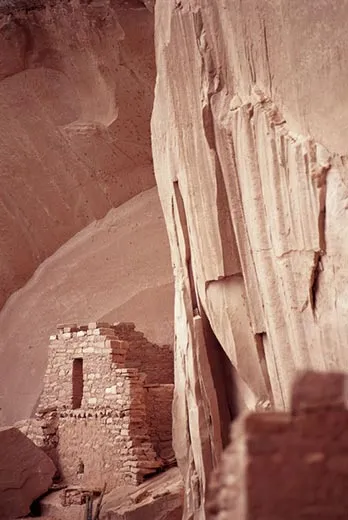
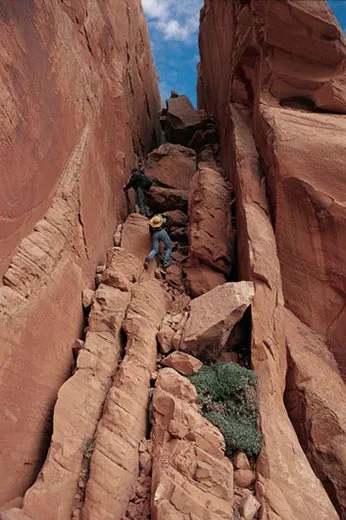
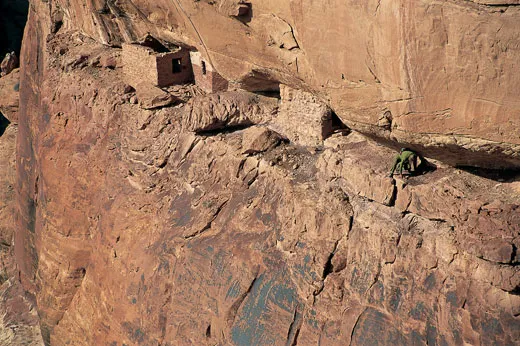
More than seven centuries ago, nonetheless, the last inhabitants of the coulee had fabricated quite a dissimilar conclusion nearly where to alive. As nosotros rounded a bend along the trail, Greg Child, an expert climber from Castle Valley, Utah, stopped and looked upwardly. "There," he said, pointing toward a nigh invisible wrinkle of ledge simply below the canyon rim. "See the dwellings?" With binoculars, we could just brand out the facades of a row of mud-and-stone structures. Up we scrambled toward them, gasping and sweating, careful not to dislodge boulders the size of modest cars that teetered on insecure perches. At last, 600 anxiety above the coulee floor, we arrived at the ledge.
The airy settlement that we explored had been built by the Anasazi, a civilisation that arose as early on as 1500 B.C. Their descendants are today's Pueblo Indians, such equally the Hopi and the Zuni, who live in xx communities forth the Rio Grande, in New Mexico, and in northern Arizona. During the tenth and 11th centuries, ChacoCanyon, in western New Mexico, was the cultural center of the Anasazi homeland, an area roughly corresponding to the 4 Corners region where Utah, Colorado, Arizona and New Mexico run across. This 30,000-foursquare-mile landscape of sandstone canyons, buttes and mesas was populated past as many as 30,000 people. The Anasazi built magnificent villages such every bit ChacoCanyon's Pueblo Bonito, a 10th-century circuitous that was every bit many as five stories tall and contained most 800 rooms. The people laid a 400-mile network of roads, some of them 30 anxiety broad, across deserts and canyons. And into their architecture they built sophisticated astronomical observatories.
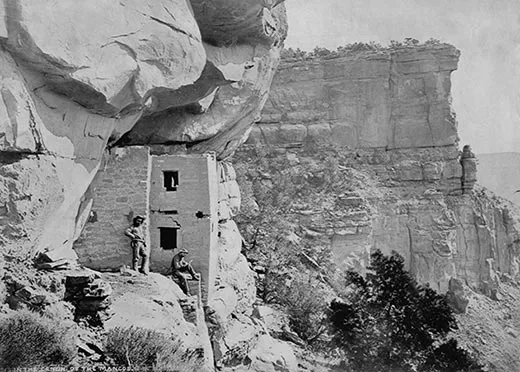
For nigh of the long span of time the Anasazi occupied the region now known every bit the Four Corners, they lived in the open or in easily accessible sites within canyons. Only about 1250, many of the people began constructing settlements loftier in the cliffs—settlements that offered defence and protection. These villages, well preserved by the dry out climate and by rock overhangs, led the Anglo explorers who establish them in the 1880s to name the absent builders the Cliff Dwellers.
Toward the stop of the 13th century, some cataclysmic upshot forced the Anasazi to flee those cliff houses and their homeland and to move southward and due east toward the Rio Grande and the Little Colorado River. But what happened has been the greatest puzzle facing archaeologists who study the ancient culture. Today'southward Pueblo Indians take oral histories about their peoples' migration, but the details of these stories remain closely guarded secrets. Within the by decade, however, archaeologists have wrung from the pristine ruins new understandings nearly why the Anasazi left, and the motion picture that emerges is night. It includes violence and warfare—fifty-fifty cannibalism—among the Anasazi themselves. "Afterwards about A.D. 1200, something very unpleasant happens," says University of Colorado archaeologist Stephen Lekson. "The wheels come up off."
This past Jan and Feb, Greg Kid, Renée Globis, Vaughn Hadenfeldt and I explored a series of canyons in southeast Utah and northern Arizona, seeking the most inaccessible Anasazi ruins we could find. I have roamed the Southwest for the by xv years and have written a book about the Anasazi. Like Greg, who has climbed Everest and K2, Renée is an adept climber; she lives in Moab, Utah, and has ascended many desert spires and cliffs. Vaughn, a tour guide from Bluff, Utah, has worked on a number of contract excavations and stone fine art surveys in southeastern Utah.
We were intrigued by the question of why the villages were built high in the cliffs, but we were equally fascinated by the "how"—how the Anasazi had scaled the cliffs, let alone lived at that place. During our outings, nosotros encountered ruins that we weren't sure we could achieve even with ropes and modern climbing gear, the utilize of which is prohibited at such sites. Researchers believe the Anasazi clambered upwards felled tree trunks that were notched by stone axes to form minuscule footholds. These log ladders were often propped on ledges hundreds of feet off the footing. (Some of the ladders are withal in identify.) Only they would not accept been acceptable to accomplish several of the dwellings we explored. I believe that archaeologists—who are usually not rock climbers—take underestimated the skill and courage information technology took to alive amidst the cliffs.
The buildings that Greg had spotted were easier to become to than most of the sites we explored. But information technology wasn't so like shooting fish in a barrel to navigate the settlement itself. As nosotros walked the ledge of the ruin, the first structure we came to was a 5-foot-tall stone wall. Four small-scale loopholes—three-inch-wide openings in the wall—would take allowed sentries to notice anyone who approached. Behind this entry wall stood a sturdy edifice, its roof still intact, that adjoined a granary littered with 700-yearold, perfectly preserved corncobs. Further along the narrow ledge, we turned a sharp corner only to be blocked by a second ruined wall. We climbed over it and connected. Twice we were forced to scuttle on our hands and knees every bit the cliff in a higher place swelled toward us, pinching down on the ledge like the jaws of a nutcracker. Our anxiety gripped the edge of the passage: 1 careless lurch meant certain decease. Finally the path widened, and nosotros came upon four splendidly masoned dwellings and another copious granary. Below u.s.a., the cliff swooped 150 feet downward, dead vertical to a gradient that dropped some other 450 anxiety to the canyon floor. The settlement, one time dwelling house to perhaps two families, seemed to exude paranoia, as if its builders lived in constant fear of attack. It was difficult to imagine elders and minor children going back and forth along such a unsafe passage. Even so the ancients must take washed simply that: for the Anasazi who lived above that void, each foray for food and h2o must have been a perilous mission.
Despite the fear that apparently overshadowed their existence, these last canyon inhabitants had taken the time to make their domicile beautiful. The outer walls of the dwellings were plastered with a smoothen coat of mud, and the upper facades painted creamy white. Faint lines and hatching patterns were incised into the plaster, creating ii-tone designs. The stone overhang had sheltered these structures then well that they looked as though they had been abased only inside the by decade—non 700 years ago.
Vertiginous cliff dwellings were non the Anasazi'due south only response to whatsoever threatened them during the 1200s; in fact, they were probably not all that mutual in the culture. This became credible a few days later when Vaughn and I, leaving our ii companions, visited Sand Canyon Pueblo in southwest Colorado, more than than l miles e of our Utah prowlings. Partially excavated betwixt 1984 and 1993 past the not-for-turn a profit Crow Canyon Archaeological Center, the pueblo comprised 420 rooms, 90 to 100 kivas (surreptitious chambers), 14 towers and several other buildings, all enclosed by a stone wall. Curiously, this sprawling settlement, whose well-thought-out architecture suggests the builders worked from a master plan, was created and abased in a lifetime, between 1240 and most 1285. Sand Canyon Pueblo looks nothing like Utah'south wildly inaccessible cliff dwellings. But there was a defense strategy built into the architecture nevertheless. "In the late 13th century," says archeologist William Lipe of Washington State University, "in that location were 50 to 75 large villages like SandCanyon in the Mesa Verde, Colorado, region—canyon-rim sites enclosing a spring and fortified with high walls. Overall, the best defense force programme confronting enemies was to aggregate in bigger groups. In southern Utah, where the soil was shallow and food hard to come by, the population density was depression, so joining a big group wasn't an selection. They congenital cliff dwellings instead."
What drove the Anasazi to retreat to the cliffs and fortified villages? And, afterward, what precipitated the exodus? For a long time, experts focused on environmental explanations. Using data from tree rings, researchers know that a terrible drought seized the Southwest from 1276 to 1299; it is possible that in certain areas there was well-nigh no rain at all during those 23 years. In addition, the Anasazi people may take about deforested the region, chopping down copse for roof beams and firewood. But environmental problems don't explain everything. Throughout the centuries, the Anasazi weathered comparable crises—a longer and more severe drought, for case, from 1130 to 1180—without heading for the cliffs or abandoning their lands.
Another theory, put forward by early explorers, speculated that nomadic raiders may have driven the Anasazi out of their homeland. But, says Lipe, "In that location's just no bear witness [of nomadic tribes in this surface area] in the 13th century. This is 1 of the most thoroughly investigated regions in the world. If there were plenty nomads to drive out tens of thousands of people, surely the invaders would have left plenty of archaeological show."
And then researchers have begun to look for the answer within the Anasazi themselves. According to Lekson, two disquisitional factors that arose after 1150—the documented unpredictability of the climate and what he calls "socialization for fright"—combined to produce long-lasting violence that tore apart the Anasazi civilization. In the 11th and early on twelfth centuries there is lilliputian archaeological evidence of true warfare, Lekson says, merely in that location were executions. Every bit he puts it, "At that place seem to have been goon squads. Things were not going well for the leaders, and the governing construction wanted to perpetuate itself by making an example of social outcasts; the leaders executed and even cannibalized them." This practise, perpetrated past ChacoCanyon rulers, created a society-wide paranoia, according to Lekson's theory, thus "socializing" the Anasazi people to live in constant fright. Lekson goes on to describe a grim scenario that he believes emerged during the next few hundred years. "Entire villages go after one another," he says, "alliance against alliance. And it persists well into the Spanish period." Every bit late as 1700, for example, several Hopi villages attacked the Hopi pueblo of Awatovi, setting fire to the community, killing all the adult males, capturing and perchance slaying women and children, and cannibalizing the victims. Bright and grisly accounts of this massacre were recently gathered from elders by NorthernArizonaUniversity professor and Hopi good Ekkehart Malotki.
Until recently, because of a popular and ingrained perception that sedentary aboriginal cultures were peaceful, archaeologists accept been reluctant to acknowledge that the Anasazi could have been trigger-happy. As University of Illinois anthropologist Lawrence Keeley argues in his 1996 book, State of war Before Civilization, experts take ignored evidence of warfare in preliterate or precontact societies.
During the concluding half of the 13th century, when war plainly came to the Southwest, even the defensive strategy of aggregation that was used at SandCanyon seems to have failed. Later excavating merely 12 percent of the site, the CrowCanyonCenter teams found the remains of eight individuals who met violent deaths—six with their skulls bashed in—and others who might have been battle victims, their skeletons left sprawling. In that location was no evidence of the formal burial that was the Anasazi norm—bodies bundled in a fetal position and placed in the ground with pottery, fetishes and other grave goods.
An even more grisly picture emerges at Castle Rock, a butte of sandstone that erupts 70 anxiety out of the bedrock in McElmoCanyon, some 5 miles southwest of SandCanyon. I went there with Vaughn to run into Kristin Kuckelman, an archaeologist with the CrowCanyonCenter who co-led a dig at the base of operations of the butte.Here, the Anasazi crafted blocks of rooms and even built structures on the butte's elevation. Crow Canyon Eye archaeologists excavated the settlement between 1990 and 1994. They detected 37 rooms, 16 kivas and ix towers, a complex that housed mayhap 75 to 150 people. Tree-band data from roof beams bespeak that the pueblo was built and occupied from 1256 to 1274—an fifty-fifty shorter menstruation than Sand Canyon Pueblo existed. "When we first started earthworks hither," Kuckelman told me, "we didn't await to discover testify of violence. Nosotros did observe human being remains that were not formally buried, and the bones from individuals were mixed together. But it wasn't until two or three years into our excavations that we realized something really bad happened here."
Kuckelman and her colleagues also learned of an ancient legend most Castle Stone. In 1874, John Moss, a guide who had spent fourth dimension amongst the Hopi, led a party that included lensman William Henry Jackson through McElmoCanyon. Moss related a story told to him, he said, by a Hopi elder; a journalist who accompanied the party published the tale with Jackson's photographs in the New York Tribune. Nearly a thousand years ago, the elderberry reportedly said, the pueblo was visited past savage strangers from the n. The villagers treated the interlopers kindly, but soon the newcomers "began to fodder upon them, and, at concluding, to massacre them and devastate their farms," said the article. In agony, the Anasazi "built houses loftier upon the cliffs, where they could store food and hide away 'til the raiders left." Notwithstanding this strategy failed. A monthlong battle culminated in carnage, until "the hollows of the rocks were filled to the brim with the mingled claret of conquerors and conquered." The survivors fled south, never to return.
By 1993, Kuckelman's coiffure had concluded that they were excavating the site of a major massacre. Though they dug just 5 percent of the pueblo, they identified the remains of at to the lowest degree 41 individuals, all of whom probably died violently. "Obviously," Kuckelman told me, "the massacre ended the occupation of Castle Rock."
More recently, the excavators at Castle Rock recognized that some of the dead had been cannibalized. They likewise plant evidence of scalping, decapitation and "face removing"—a do that may take turned the victim'south head into a deboned portable trophy.
Suspicions of Anasazi cannibalism were first raised in the late 19th century, just it wasn't until the 1970s that a handful of physical anthropologists, including Christy Turner of Arizona State University, actually pushed the argument. Turner'due south 1999 volume, Man Corn, documents evidence of 76 different cases of prehistoric cannibalism in the Southwest that he uncovered during more than 30 years of research. Turner developed half-dozen criteria for detecting cannibalism from basic: the breaking of long basic to become at marrow, cut marks on bones fabricated past stone knives, the burning of bones, "anvil abrasions" resulting from placing a bone on a stone and pounding it with some other rock, the pulverizing of vertebrae, and "pot polishing"—a sheen left on basic when they are boiled for a long time in a clay vessel. To strengthen his argument, Turner refuses to attribute the impairment on a given set up of basic to cannibalism unless all half dozen criteria are met.
Predictably, Turner's claims aroused controversy. Many of today's Pueblo Indians were deeply offended by the allegations, as were a number of Anglo archaeologists and anthropologists who saw the assertions as exaggerated and role of a design of condescension toward Native Americans. Even in the face of Turner'southward prove, some experts clung to the notion that the "farthermost processing" of the remains could have instead resulted from, say, the mail-mortem destruction of the bodies of social outcasts, such as witches and deviants. Kurt Dongoske, an Anglo archaeologist who works for the Hopi, told me in 1994, "As far as I'm concerned, you lot can't show cannibalism until you actually find human being remains in human coprolite [fossilized excrement]."
A few years later, Academy of Colorado biochemist Richard Marlar and his team did merely that. At an Anasazi site in southwestern Colorado called CowboyWash, excavators found iii pit houses—semi-subterranean dwellings—whose floors were littered with the disarticulated skeletons of seven victims. The bones seemed to comport most of Christy Turner's hallmarks of cannibalism. The team besides institute coprolite in ane of the pit houses. In a study published in Nature in 2000, Marlar and his colleagues reported the presence in the coprolite of a man protein called myoglobin, which occurs only in human being muscle tissue. Its presence could take resulted simply from the consumption of homo flesh. The excavators likewise noted show of violence that went beyond what was needed to kill: one child, for instance, was smashed in the mouth so hard with a guild or a stone that the teeth were broken off. Every bit Marlar speculated to ABC News, defecation side by side to the expressionless bodies 8 to xvi hours after the act of cannibalism "may take been the final desecration of the site, or the degrading of the people who lived there."
When the Castle Rock scholars submitted some of their artifacts to Marlar in 2001, his analysis detected myoglobin on the inside surfaces of two cooking vessels and one serving vessel, as well equally on iv hammerstones and 2 rock axes. Kuckelman cannot say whether the Castle Rock cannibalism was in response to starvation, but she says information technology was clearly related to warfare. "I feel differently virtually this place at present than when we were working hither," a pensive Kuckelman told me at the site. "We didn't take the whole picture then. Now I feel the full tragedy of the identify."
That the Anasazi may have resorted to violence and cannibalism under stress is non entirely surprising. "Studies indicate that at to the lowest degree a 3rd of the globe's cultures have proficient cannibalism associated with warfare or ritual or both," says WashingtonStateUniversity researcher Lipe. "Occasional incidents of 'starvation cannibalism' have probably occurred at some time in history in all cultures."
From Colorado, I traveled s with Vaughn Hadenfeldt to the Navajo Reservation in Arizona. We spent four more days searching amid remote Anasazi sites occupied until the great migration. Because hiking on the reservation requires a permit from the Navajo Nation, these areas are even less visited than the Utah canyons. Three sites nosotros explored sat atop mesas that rose 500 to 1,000 anxiety, and each had just ane reasonable route to the peak. Although these aeries are at present within view of a highway, they seem so improbable as habitation sites (none has h2o) that no archaeologists investigated them until the late 1980s, when husband-and-wife team Jonathan Haas of Chicago's Field Museum and Winifred Creamer of Northern Illinois University made extensive surveys and dated the sites by using the known ages of different styles of pottery establish there.
Haas and Creamer advance a theory that the inhabitants of these settlements developed a unique defense strategy. Equally we stood atop the northernmost mesa, I could see the second mesa simply southeast of us, though not the third, which was farther to the east; yet when nosotros got on top of the third, we could see the second. In the KayentaValley, which surrounded u.s.a., Haas and Creamer identified x major villages that were occupied after 1250 and linked by lines of sight. It was non difficulty of access that protected the settlements (none of the scrambles we performed here began to compare with the climbs we fabricated in the Utah canyons), but an brotherhood based on visibility. If one hamlet was under attack, it could send signals to its allies on the other mesas.
Now, as I sat amidst the tumbled ruins of the northernmost mesa, I pondered what life must have been similar here during that dangerous time. Around me lay sherds of pottery in a style chosen Kayenta blackness on white, decorated in an endlessly baroque elaboration of tiny grids, squares and hatchings—evidence, once once again, that the inhabitants had taken fourth dimension for artistry. And no doubt the pot makers had plant the view from their mesa-summit home lordly, as I did. Merely what made the view well-nigh valuable to them was that they could encounter the enemy coming.
Archaeologists now generally agree about what they call the "push" that prompted the Anasazi to abscond the Four Corners region at the end of the 13th century. It seems to have originated with environmental catastrophes, which in plough may take given birth to violence and internecine warfare later on 1250. Yet hard times lone do not account for the mass abandonment—nor is it clear how resettling in another location would accept solved the problem. During the past 15 years, some experts take increasingly insisted that there must likewise have been a "pull" drawing the Anasazi to the south and east, something so appealing that it lured them from their ancestral homeland. Several archaeologists have argued that the pull was the Kachina Cult. Kachinas are not simply the dolls sold today to tourists in Pueblo gift shops. They are a pantheon of at least 400 deities who intercede with the gods to ensure rain and fertility. Even today, Puebloan life often revolves around Kachina behavior, which promise protection and procreation.
The Kachina Cult, maybe of Mesoamerican origin, may take taken agree among the relatively few Anasazi who lived in the Rio Grande and Piffling Colorado River areas nearly the time of the exodus. Bear witness of the cult's presence is found in the representations of Kachinas that announced on aboriginal kiva murals, pottery and rock art panels virtually the Rio Grande and in south-central Arizona. Such an evolution in religious thinking amongst the Anasazi farther s and eastward might take caught the attention of the farmers and hunters eking out an increasingly desperate existence in the Four Corners region. They could have learned of the cult from traders who traveled throughout the area.
Unfortunately, no 1 can exist sure of the age of the Rio Grande and southern Arizona Kachina imagery. Some archaeologists, including Lipe and Lekson, argue that the Kachina Cult arose too late to have triggered the 13th-century migration. Then far, they insist, in that location is no firm evidence of Kachina iconography anywhere in the Southwest before A.D. 1350. In any instance, the cult became the spiritual center of Anasazi life before long after the great migration. And in the 14th century, the Anasazi began to amass in fifty-fifty larger groups—erecting huge pueblos, some with up of 2,500 rooms. Says Stephen Lekson, "You demand some sort of social gum to hold together such large pueblos."
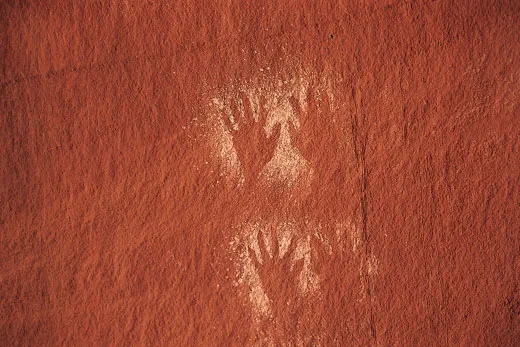
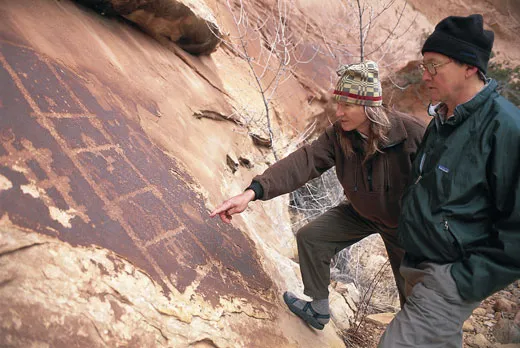
the day after exploring the KayentaValley, Vaughn and I hiked at dawn into the labyrinth of the TsegiCanyon system, due north of the line-of-sight mesas. Two hours in, we scrambled upwardly to a sizable ruin containing the remains of some 35 rooms. The wall behind the structures was covered with pictographs and petroglyphs of ruddy brown bighorn sheep, white lizard-men, outlines of easily (created by blowing mucilaginous paint from the rima oris against a mitt held apartment on the wall) and an extraordinary, artfully chiseled 40-foot-long serpent.
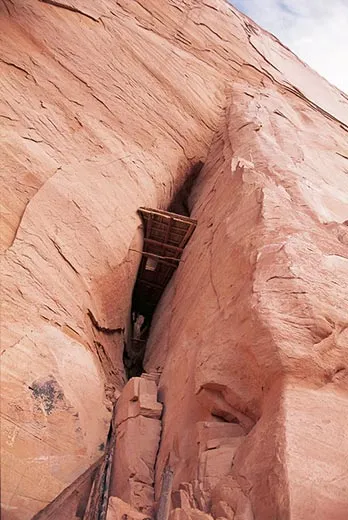
One structure in the ruin was the nearly amazing Anasazi creation I have always seen. An exquisitely crafted wooden platform built into a huge flaring crack hung in place more 30 feet to a higher place the states, impeccably preserved through the centuries. Information technology was narrow in the rear and wide in the front, perfectly fitting the contours of the fissure. To construct information technology, the builders had pounded loving cup holes in the side walls and wedged the ax-hewn ends of massive cross-beams into them for support. These were overlaid with more than beams, topped by a latticework of sticks and finally covered completely with mud. What was the platform used for? No one who has seen it has offered me a convincing explanation. As I stared up at this woodwork masterpiece, I toyed with the fancy that the Anasazi had built it "just because": art for art'southward sake.
The Tsegi Canyon seems to have been the last place where the Anasazi hung on as the 13th century drew to a shut. The site with the wooden platform has been dated past Jeffrey Dean of the Arizona Tree-Ring Laboratory to 1273 to 1285. Dean dated nearby Betatakin and Keet Seel, 2 of the largest cliff dwellings ever congenital, to 1286—the oldest sites discovered so far within the abandoned region. It would seem that all the strategies for survival failed after 1250. Merely before 1300, the terminal of the Anasazi migrated s and eastward, joining their distant kin.
"State of war is a dismal study," Lekson concludes in a landmark 2002 paper, "War in the Southwest, State of war in the World." Contemplating the carnage that had destroyed Castle Rock, the fear that seemed congenital into the cliff dwellings in Utah, and the elaborate alliances developed in the KayentaValley, I would have to concur.
Yet my wanderings this past winter in search of 13th-century ruins had amounted to a sustained idyll. Still pragmatic the ancients' motives, terror had somehow given birth to beauty. The Anasazi produced slap-up works of art—villages such as Mesa Verde's Cliff Palace, hallucinatory petroglyph panels, some of the near cute pottery in the globe—at the same fourth dimension that its people were capable of cruelty and violence. Warfare and cannibalism may accept been responses to the stresses that peaked in the 13th century, only the Anasazi survived. They survived non but whatever crunch struck presently subsequently 1250, but also the assaults of the Spanish conquest in the 16th century and the Anglo-American invasion that began in the 19th. From Taos Pueblo in New Mexico to the Hopi villages in Arizona, the Pueblo people today however dance their traditional dances and still pray to their own gods. Their children speak the languages of their ancestors. The aboriginal civilization thrives.
Source: https://www.smithsonianmag.com/history/riddles-of-the-anasazi-85274508/
0 Response to "what led to the decline in both the hohokam and anasazi cultures?"
Post a Comment